One Light-Day: A 1977 Machine Hits the Edge of a Day, the Night Before GTA 6
NASA's Voyager 1 spacecraft, launched from Cape Canaveral on September 5, 1977, will be exactly one light-day from Earth on Wednesday, November 18, 2026, at 2:16:07 a.m. Pacific, 5:16:07 a.m. in New York. That is 16.094 billion miles (25.902 billion kilometers), the distance light covers in 24 hours, according to NASA.
The next morning, Thursday, November 19, Grand Theft Auto VI comes out. One of the most anticipated pieces of software ever made, landing on consoles with hundreds of thousands of times the memory of Voyager's computers, the day after a box of 1970s electronics crosses a line no human-made object has crossed before.
If you say "hello" to Voyager 1 at the moment GTA 6 unlocks at midnight, it hears you around midnight the next night. If it answers, you hear back the night after that. And it still answers.
What a light-day actually means
Light is the speed limit, and radio is light. Every message to Voyager 1 travels at 186,282 miles a second and still needs a full day to get there after November 18. A question and an answer is a two-day round trip. Nothing about that can be engineered away; it is the size of the solar system written in time.
For a sense of scale: the Moon is about 1.3 light-seconds away. The Sun is about 8 light-minutes. Voyager 1 is now about to be 1,440 light-minutes out, and it got there on a single shove from a Titan IIIE-Centaur rocket and two gravity assists, at Jupiter and Saturn, almost half a century ago.
One wrinkle: Earth goes around the Sun while Voyager heads away, so the distance between us wobbles a little through the year. November 18 is the first time the line gets crossed. Expect the occasional headline about Voyager "getting closer" as Earth swings back toward it; the long-term direction is out.
The trip, in five stops
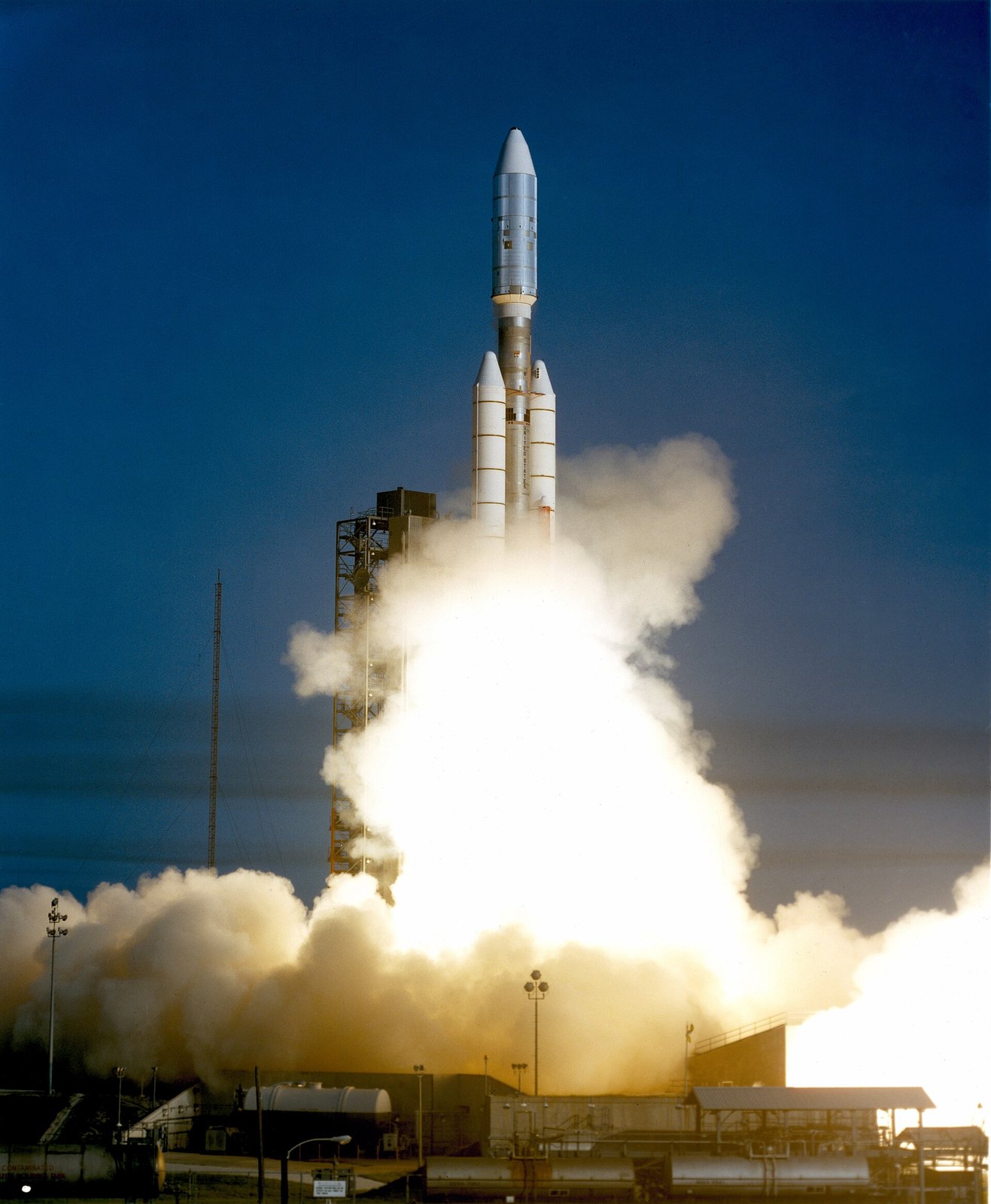
Launch
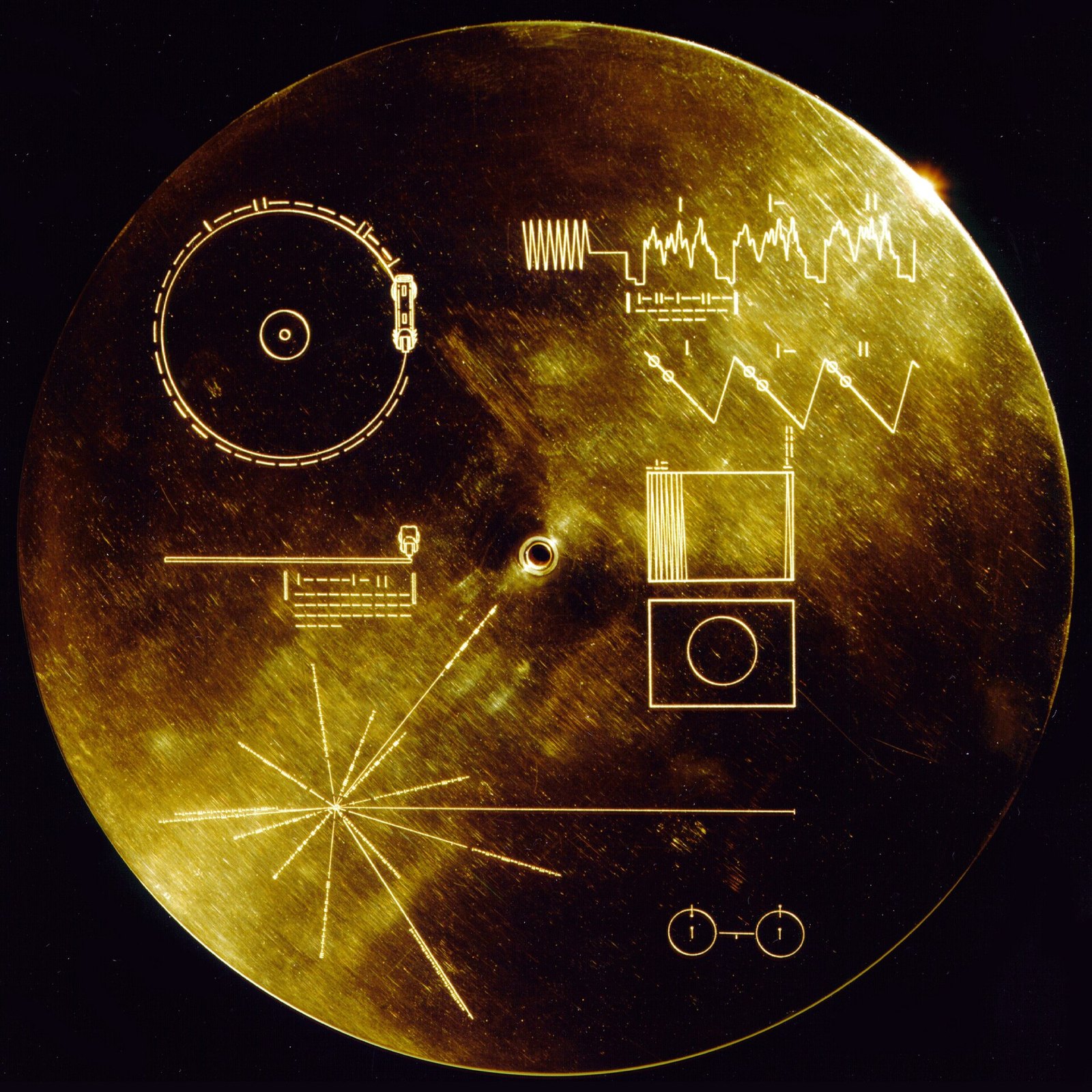
Voyager 1 lifts off sixteen days after its twin, Voyager 2, on a faster path. Aboard is a gold-plated copper record carrying greetings in 55 languages, 115 images, the sounds of Earth and 90 minutes of music, in case anyone ever finds it.
Jupiter
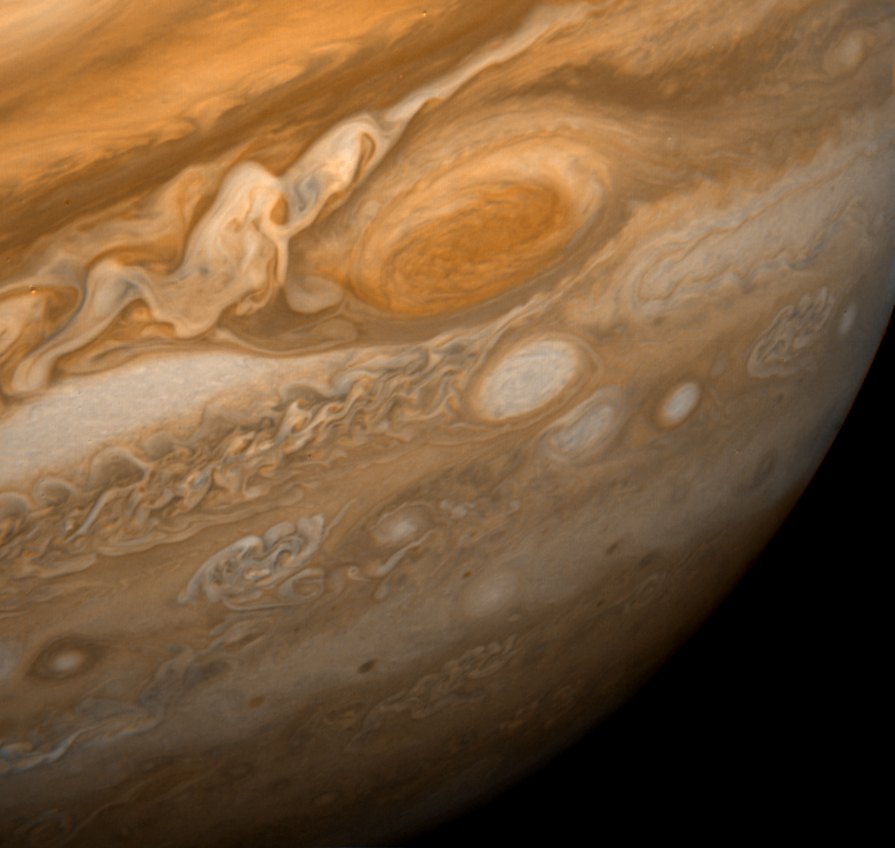
Closest approach to Jupiter. Voyager 1 finds active volcanoes on the moon Io, the first ever seen beyond Earth, and sends back the Great Red Spot in a level of detail nobody had seen.
Saturn, and the exit
Closest approach to Saturn and a close pass of its moon Titan. The Titan flyby bends the trajectory up and out of the plane of the planets. There are no more stops after this.
The last pictures
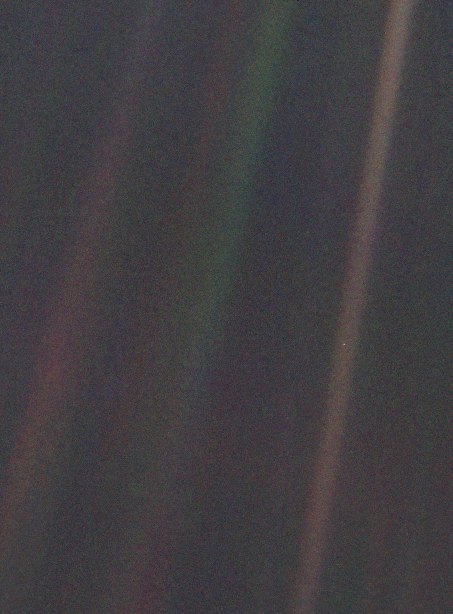
From about 40 times the Earth-Sun distance, Voyager 1 turns around and photographs the planets, including Earth as a single pale pixel. The same day, the cameras are switched off for good to save power.
Interstellar space
Voyager 1 becomes the first human-made object to leave the heliosphere, the bubble of solar wind around the Sun, and start measuring the space between the stars.
How you actually send it a message
This is the part that sounds made up and isn't. Here is the chain, link by link, from NASA's own engineering description of the Voyager radio system, published by JPL's DESCANSO program.
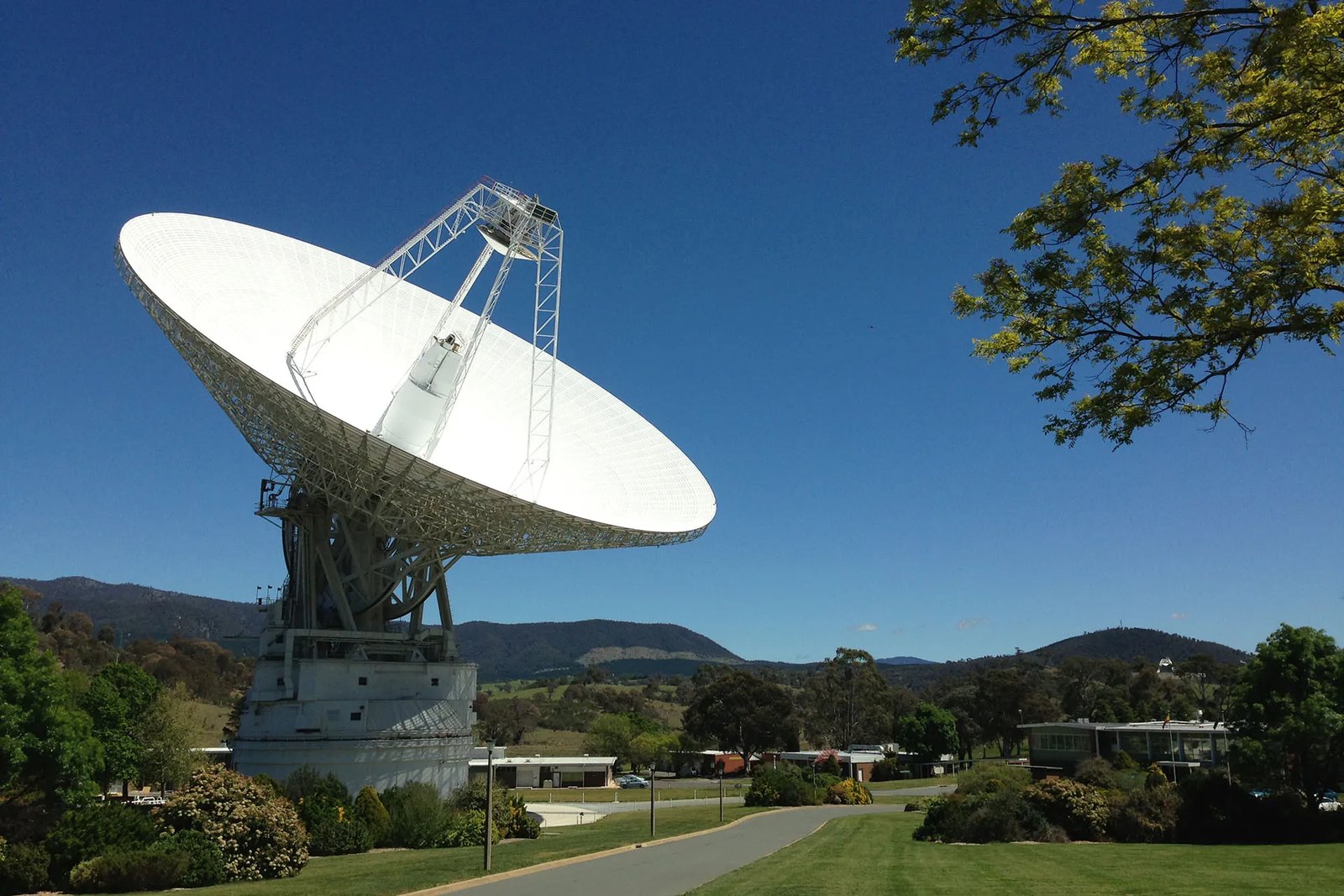
1. Only one antenna on Earth can do it. Voyager 1 is so far away that only one dish has enough power to reach it with commands: Deep Space Station 43, a 70-meter (230-foot) antenna at the Canberra Deep Space Communication Complex in Australia. JPL says it is "the only dish with enough signal power to send commands to the Voyagers." The dishes at Goldstone, California and Madrid can listen. They cannot talk.
2. It shouts at 18,000 watts. DSS-43 transmits the command signal at 18 kilowatts on S-band, about 2.1 gigahertz, not far from the frequencies your Wi-Fi uses. By the time that beam reaches Voyager, spread across a day's worth of space, almost none of it is left.
3. It talks slowly, on purpose. Commands go up at 16 bits per second. That is not a typo. A single 160-character text message would take more than a minute to send. The bits are Manchester-encoded: every bit is sent as a flip, high-to-low or low-to-high, so the receiver can find the rhythm even when the signal is buried in noise. That stream rides on a 512 Hz square-wave subcarrier.
4. The language is the machine's. There is no chat window. The flight team writes command sequences on the ground, checks them against software models of the spacecraft, and sends them up as raw instructions for Voyager's computers. One of them, the Flight Data Subsystem, runs in assembly language on 16-bit words. IEEE Spectrum reports each of the three onboard computers has 69.63 kilobytes of memory, less than most of the photos on this page.
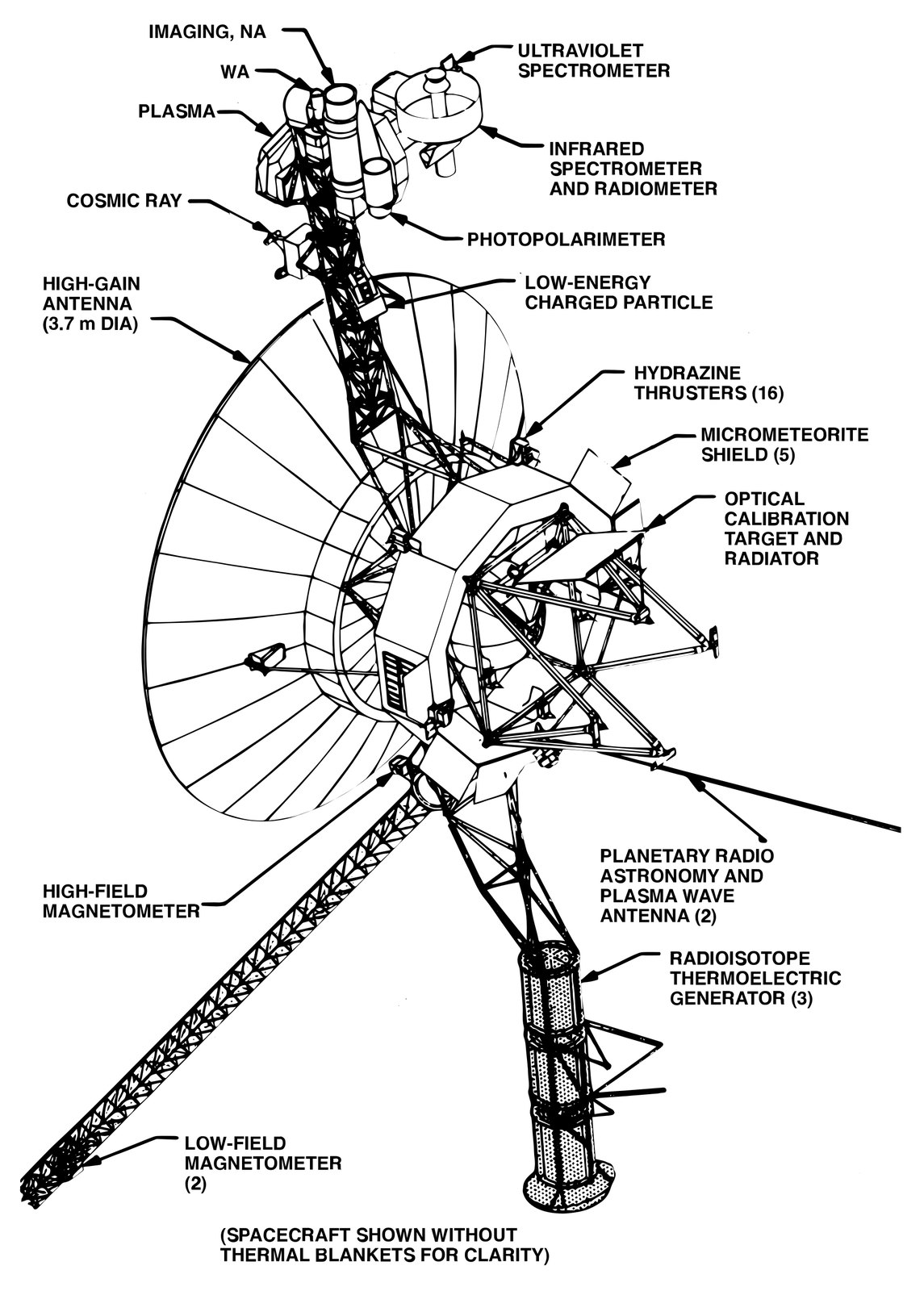
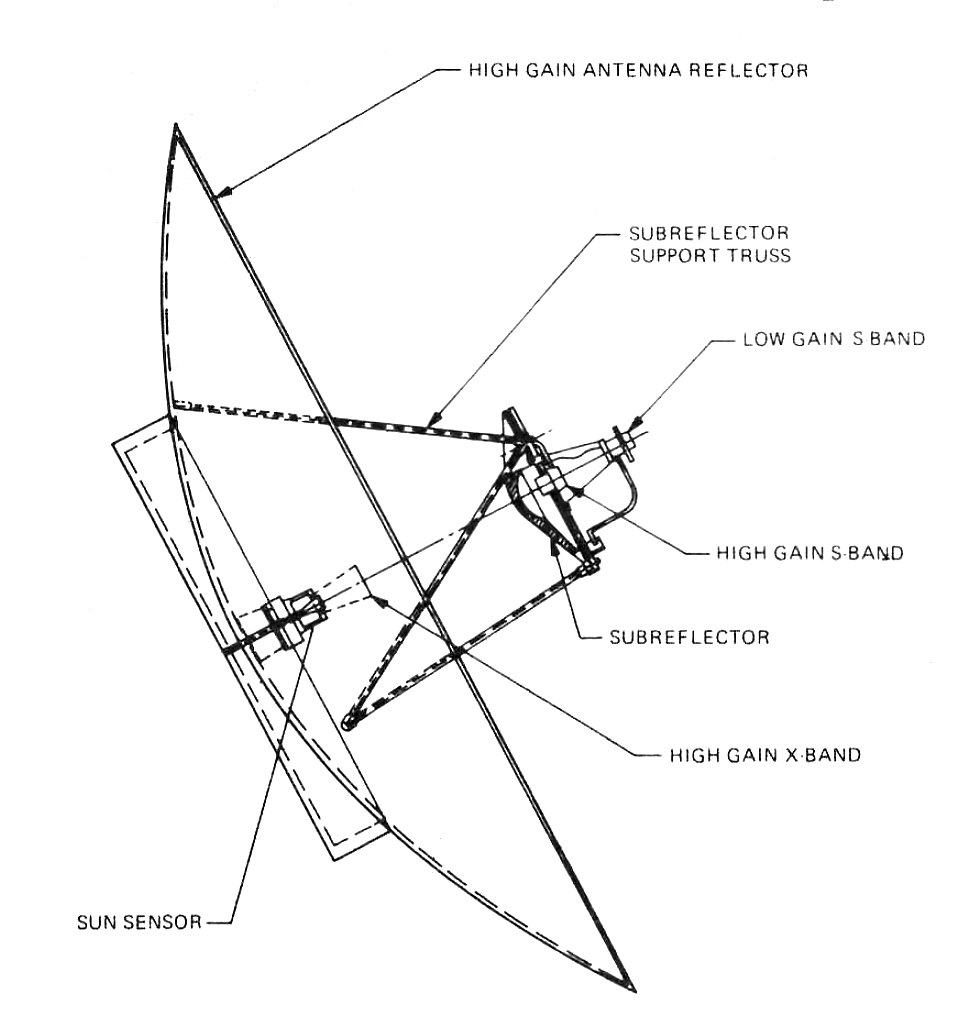
5. Voyager answers with a light bulb. The reply goes back on X-band, about 8.4 gigahertz, from a dish 3.66 meters across, which was the largest solid reflector ever flown when it launched. The transmitter puts 12 or 18 watts into that dish. That is roughly a refrigerator bulb, aimed at a planet a light-day away. NASA lists the science data rate at 160 bits per second.
6. Error-correcting math does the rest. A signal that weak arrives full of errors. Voyager carried an experimental Reed-Solomon encoder for the outer planets, which cut the error rate in the received data from 5 in 1,000 bits to 1 in a million. The same family of codes later went into CDs, DVDs and QR codes.
| Earth to Voyager 1 | Voyager 1 to Earth | |
|---|---|---|
| Antenna | DSS-43, 70 m, Canberra | 3.66 m high-gain dish |
| Power | 18,000 watts | 12 or 18 watts |
| Frequency | S-band, about 2.1 GHz | X-band, about 8.4 GHz |
| Speed | 16 bits per second | 160 bits per second (science) |
| Travel time after Nov. 18 | 24 hours | 24 hours |
The weekly "are you still there"
Voyager assumes the worst about itself. Onboard is a Command Loss timer. If too long goes by without a valid command from Earth, the spacecraft concludes its own radio has failed and starts swapping to backup hardware, one piece at a time, trying to hear us again. It will run that routine four times. If it still hears nothing, it switches to a Backup Mission Load, a stored plan to keep doing science on its own.
So every week, the team sends a command whose only job is to reset that timer. It is the oldest keep-alive ping in the solar system.
Fixing a computer from a day away
In November 2023, Voyager 1 started sending back gibberish. Engineers ordered a full readout of the Flight Data Subsystem's memory and found the cause: one memory chip had failed. You cannot replace a chip 15 billion miles away, so the team rewrote the affected code, split it into pieces small enough to fit in the gaps left in memory, and moved it around the dead spot. There was so little room that they had to delete code for data modes nobody uses anymore.
The first fix went up through the Deep Space Network on April 18, 2024. The signal took about 22.5 hours to arrive. Readable data came back on April 20. "The size of the memory was the biggest challenge in this anomaly," project scientist Linda Spilker told IEEE Spectrum.
In March 2025 they did it again with hardware. Voyager 1's primary roll thrusters had been written off as dead since 2004. The team suspected a heater circuit switch had flipped the wrong way, sent the commands to flip it back, and waited a day to find out. The heaters warmed up. "It was such a glorious moment," propulsion lead Todd Barber told JPL.
Running on what's left
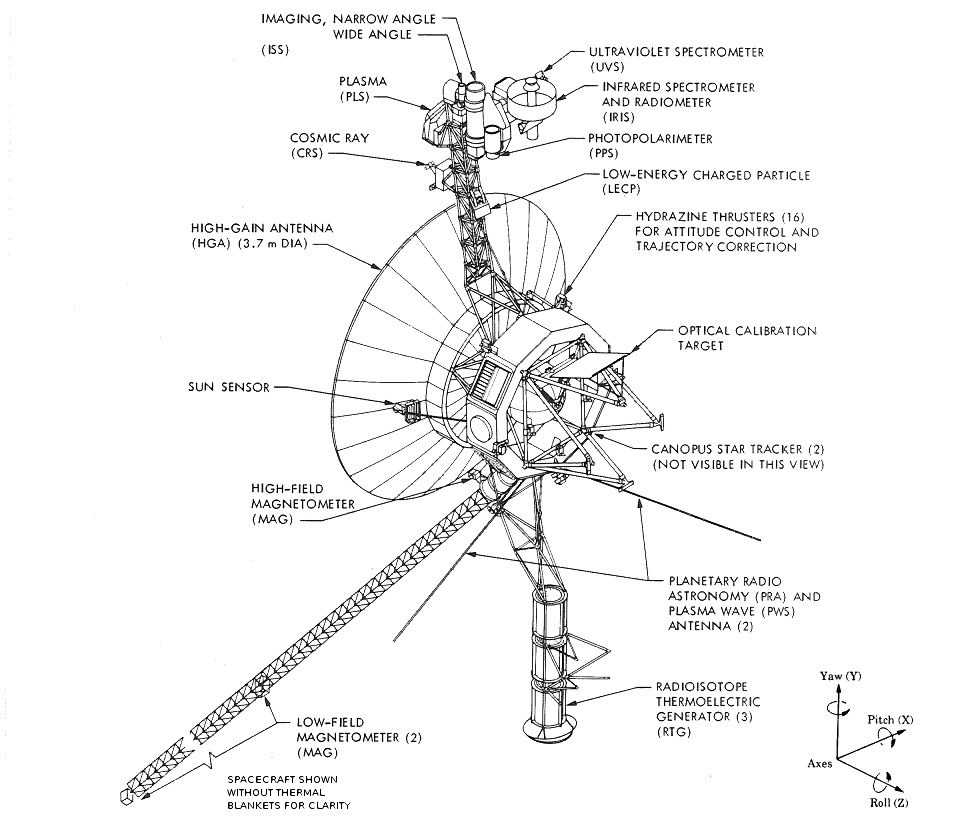
Voyager 1 runs on three radioisotope thermoelectric generators, which turn the heat of decaying plutonium into electricity. At launch they made about 158 watts each. That output drops every year, so NASA has been switching instruments off one by one: the cameras in 1990, the cosmic ray instrument in February 2025, the low-energy charged particle instrument in April 2026. As of now, two science instruments are still working.
Parts of it have already died. One of its two X-band transmitter amplifiers failed in 1987. Its ultra-stable oscillator failed in 1992. The team keeps routing around the losses, because the alternative is silence.
The day before Vice City
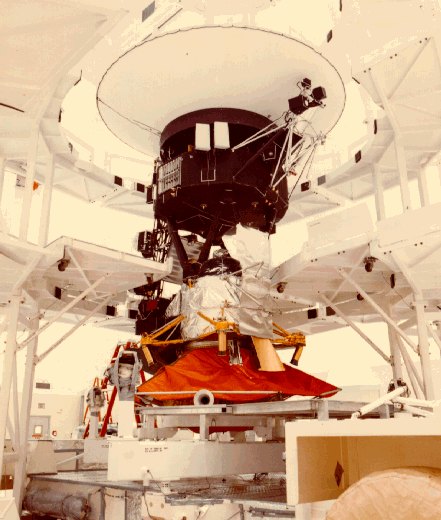
On November 19, millions of people will start a game built by thousands of people, running on hardware that can draw a whole city in real time. The night before, a machine with 69.63 kilobytes per computer, a 12-watt voice and a record player bolted to its side will quietly be one light-day from home.
Both are worth a moment. Only one of them has been getting its patches from a full day away, for 49 years.
Sources
- NASA Science, "Where Are Voyager 1 and Voyager 2 Now?": the one light-day time and distance; instrument status
- NASA Science, Voyager 1 mission page: launch, flybys, power, Golden Record
- JPL DESCANSO, "Voyager Telecommunications": uplink and downlink, 16 bps commands, 18 kW uplink, 12/18 W transmitters, Reed-Solomon, Command Loss and Backup Mission Load
- JPL News, "NASA's Voyager 1 Revives Backup Thrusters Before Command Pause"
- IEEE Spectrum, the 2024 Flight Data Subsystem memory fix
- EarthSky, "Voyager 1 to reach 1 light-day from Earth on November 18"
- Grand Theft Auto VI release date (November 19, 2026): Rockstar Games, as reported by TechRadar
Images
- Voyager spacecraft diagram (blueprint): NASA/JPL, SVG by Haroenv, Wikimedia Commons (public domain)
- Titan IIIE launch of Voyager 1: NASA, Wikimedia Commons (public domain)
- Great Red Spot from Voyager 1: NASA, Wikimedia Commons (public domain)
- Pale Blue Dot: NASA/JPL, Wikimedia Commons (public domain)
- Deep Space Station 43: NASA/JPL-Caltech, Wikimedia Commons (public domain)
- Voyager high-gain antenna diagram: NASA/JPL, Wikimedia Commons (public domain)
- Voyager spacecraft structure: NASA, derivative by Mirecki, Wikimedia Commons (public domain)
- Voyager in assembly: NASA, Wikimedia Commons (public domain)
- Golden Record cover: NASA/JPL, Wikimedia Commons (public domain)


